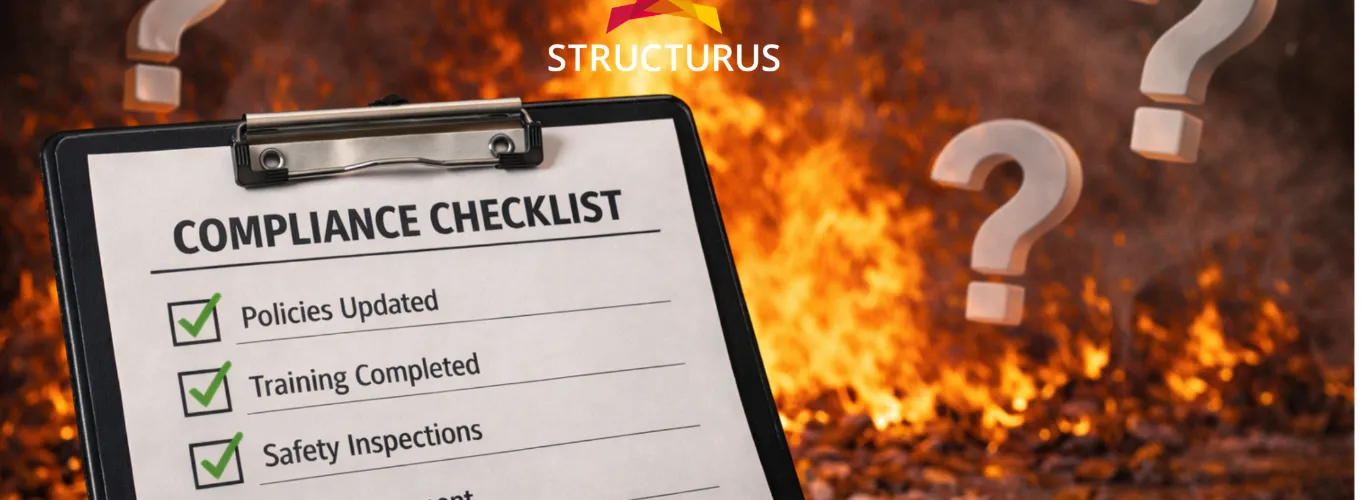
If you are responsible for incident response, you live in two realities.
One is regulatory.
Policies are updated. Training hours are logged. Exercises are documented. Audits are passed.
The other is operational.
You know that a real incident will not follow the structure of your compliance binder.
Regulatory frameworks such as NFPA 1620 for pre-incident planning emphasize structured preparation and hazard identification https://www.nfpa.org.
OSHA standards require emergency action planning and training https://www.osha.gov.
These are essential foundations.
But passing an audit does not guarantee performance under pressure.
The Daily Tension
Most response leads face the same constraints:
Limited training windows.
Distributed teams.
Budget scrutiny.
Executive pressure to remain compliant.
Classroom sessions check documentation requirements.
Tabletop exercises validate understanding.
Yet when you picture a real escalation, you know the real test is spatial, dynamic, and time-critical.
You are not worried about whether people know the procedure exists.
You are concerned whether they can execute it in context.
Where Readiness Breaks Down
Incidents introduce variables that are hard to replicate:
Restricted access routes.
Communication lag between roles.
Delayed isolation.
Competing priorities in the first five minutes.
These are not compliance gaps. They are performance gaps.
This is where simulation platforms like STRX become relevant.
Not as a replacement for documentation, but as a performance layer.
Teams can operate inside realistic 3D environments that mirror actual facilities.
Scenarios can escalate in controlled ways.
Multiple users can coordinate in real time.
The objective is not to create drama.
It is to reveal friction before a real incident does.
The Shift From Explaining to Experiencing
Traditional formats explain response.
Immersive simulation tests response.
That difference matters.
When responders must move through a digital twin of their environment, they confront layout, timing, and coordination challenges that slides cannot expose.
For the incident lead, this reduces uncertainty.
It strengthens briefings.
It improves debriefs.
It gives clarity on where capability is strong and where it needs reinforcement.
The Real Standard
Compliance is the baseline.
Operational confidence is the goal.
If you are responsible for emergency response capability, your concern is not simply passing the next audit. It is knowing that when escalation happens, your team will act with discipline and coordination.
If that conversation is already happening internally, it may be time to explore technology tools designed to test performance, not just knowledge.
To discuss this further, contact info@structurus.com.