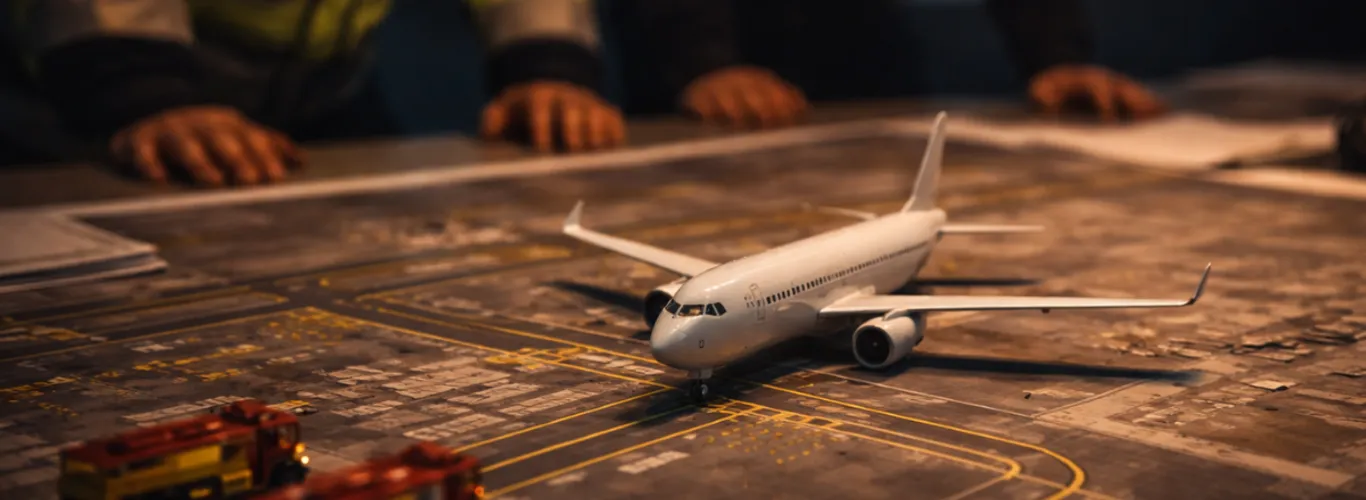
Aviation incidents are rarely simple.
They involve multiple teams, fast decisions, restricted areas, changing conditions, and constant communication.
Yet many aviation tabletop exercises still rely on the same format:
A room.
A slide deck.
A verbal scenario.
Participants imagine the event and talk through what they would do.
That approach has value. It helps review procedures and roles.
But it also has limits.
The Problem With Abstract Training
When participants cannot see the environment, key decisions become theoretical.
Where is the nearest access route?
Can emergency vehicles reach the aircraft from one side?
How close is the terminal?
What happens if smoke affects visibility?
These questions matter in aviation response.
Without visual context, teams rely only on assumptions.
Why Realism Changes Performance
When teams can see the incident unfold before their eyes inside a shared environment, comprehension changes.
They understand positioning faster.
They coordinate movement more clearly.
They react to changing conditions together.
Instead of imagining the incident, they operate through it.
This improves two critical areas:
Collaboration – Teams work from the same picture.
Decision speed – Fewer delays caused by uncertainty.
The Modern Tabletop Model
Aviation tabletop exercises do not need to remain static.
Modern platforms such as STRX Tabletop allow teams to run scenarios inside interactive environments where incidents can be viewed, navigated, and managed together.
This creates exercises that are:
More engaging
More realistic
Easier to follow
More useful operationally
Final Thought
Aviation emergency response depends on coordination under pressure.
Training should reflect that.
If an exercise feels abstract, its value is limited.
If it feels real, teams perform differently.