A team does not become ready because it attended one course, completed one exercise or purchased one piece of equipment.
Readiness is built in layers.
People need knowledge. They need practical experience. They need to understand their site. They need to practise decision making. They need to know how their equipment works. They also need opportunities to train regularly without closing facilities, disrupting operations or recreating dangerous conditions.
This is where the emergency response training sector can become fragmented.
One supplier designs a training facility. Another provides fire training equipment. Another delivers practical courses. A separate software company provides virtual simulation. Tabletop exercises may then be managed through slides, printed maps and handwritten notes.
Each part may be useful on its own.
The problem is that they do not always connect.
The physical foundation
There is no complete replacement for practical training.
Firefighters and emergency response teams need to experience heat, restricted visibility, heavy equipment, breathing apparatus, hose handling and the physical pressure of working as part of a response team.
Purpose built training facilities allow this to happen in a controlled environment.
These facilities can represent aircraft incidents, industrial fires, structural emergencies, hazardous material events, marine environments and other risks that responders may encounter.
Structurus supports the design and development of fire and rescue training facilities for civil defence, municipal fire services, aviation and industrial organisations.
The aim is not simply to construct a collection of fire props.
A useful training facility must reflect the risks faced by the people who will use it. An airport fire crew has different requirements from a refinery emergency response team. A civil defence academy may need to prepare teams for structural fires, confined spaces, hazardous materials and search and rescue.
The environment must serve the training objective.
Practical skills and specialist equipment
A training facility is only useful when it is supported by relevant training and equipment.
Structurus provides access to live fire and specialist emergency response training simulation for civil, aviation and industrial teams.
This includes training in structural firefighting, aircraft rescue and firefighting, industrial emergency response and other specialist areas.
Aviation also introduces another important challenge.
Structurus supports airports, airlines and military air forces with a wide range of simulation solutions that enable realistic training by combining the real and virtual environments.
Digital training between practical exercises
Live training is necessary, but it cannot always be delivered frequently.
It requires instructors, facilities, equipment, travel, fuel, water, safety controls and time away from normal operations.
Digital training helps teams practise between major exercises.
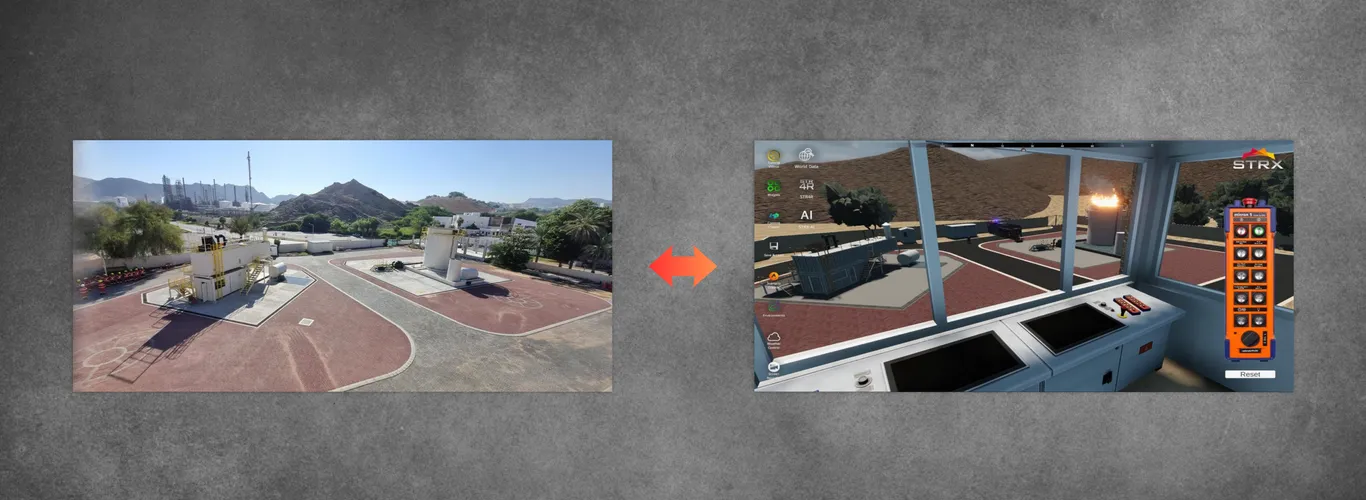
STRX provides interactive 3D and VR emergency response training inside digital environments. These environments can include digital twins of real facilities, allowing teams to become more familiar with the places where they may eventually have to respond.
A refinery team can practise inside a representation of its own site.
An airport team can rehearse an aircraft incident using its own airfield layout.
A fire service can work through command decisions and resource deployment without needing to recreate the incident physically.
Digital simulation does not replace live fire simulation.
It makes regular training more practical.
Teams can repeat scenarios, change conditions and expose more people to incidents that would be difficult, expensive or unsafe to reproduce in the real world.
Command training and tabletop exercises
Physical skills are only one part of emergency response.
Major incidents also depend on communication, command, coordination and decision making.
This is the role of tabletop exercises.
Traditional tabletop exercises often rely on slide presentations, printed maps and discussion. These methods are familiar and can still be useful, but they place a large administrative burden on the exercise team.
Someone must prepare the slides.
Someone must update the map.
Someone must record the decisions.
Someone must collect the notes and turn them into a report.
STRX Tabletop brings the exercise into a shared browser-based environment.
Incidents, hazards, vehicles, staging areas, access routes and other information can be placed onto a live visual scene as the scenario develops.
The Facilitator controls the direction of the exercise. The Operator updates the scene. Participants can focus on their roles and decisions.
The exercise then produces a structured record that can support the final report and future training.
This matters because the real value of a tabletop exercise is not conversation alone.
It is what the organisation learns and changes afterwards.
Connecting the complete training journey
There are many strong specialists in emergency response.
Some focus on live fire simulation facilities.
Some manufacture firefighting equipment.
Some operate training academies.
Some build simulation software.
Others specialise in incident command.
What is less common is bringing these areas together as one connected training journey.
Structurus works across physical facilities, practical instruction, specialist equipment, virtual simulation, digital twins and tabletop exercise software.
This does not mean every customer needs every service.
It means the training approach can be built around the actual requirement.
A team might begin by reviewing its physical training facilities.
Another may already conduct major live exercises but need a more frequent way to practise inside its own site.
A third may want to improve how tabletop exercises are delivered and reported.
These are different problems, but they are connected by the same objective.
Operational readiness.
More than a single training event
Emergency response capability cannot be purchased once and considered complete.
People change roles. Procedures are updated. Sites expand. Aircraft and equipment change. New hazards appear. Skills fade when they are not used.
A complete training strategy must therefore provide different levels of practice.
Teams need classroom knowledge.
They need practical exercises.
They need live fire exposure.
They need equipment training.
They need site familiarisation.
They need command and decision training.
They need digital tools that allow these activities to happen more often.
Structurus brings these parts together to support emergency response teams working across civil defence, aviation, oil and gas, and fire and rescue.
From the training ground to the digital twin, and from live fire to the tabletop, every layer should prepare the team for the same moment.
The moment when training becomes a real response.