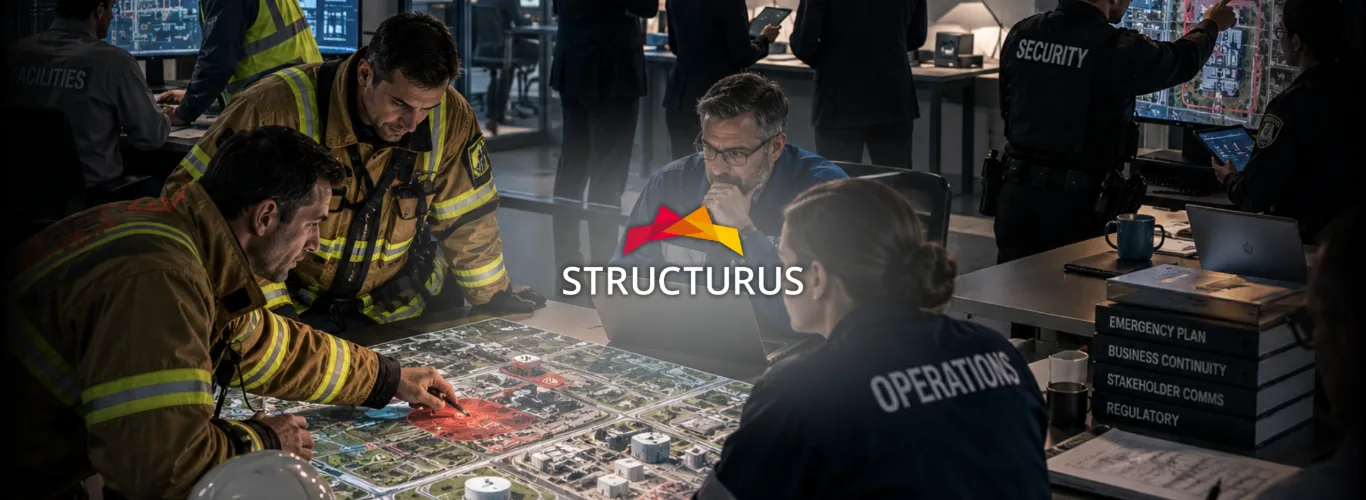
Imagine a serious incident developing at a large industrial site.
For the emergency response team, the immediate question might be how to protect life and bring the hazard under control.
For Operations, the question could be whether part of the facility needs to shut down.
Security may be thinking about access, evacuation routes and controlling movement around the site.
Facilities may be concerned about utilities, damaged infrastructure or whether important systems will remain available.
Senior management may already be looking at business continuity, external communications and the wider impact on the organisation.
They are all responding to the same incident.
But they are not necessarily dealing with the same problem.
Different priorities are normal
This is easy to overlook when emergency plans are written.
A plan can describe responsibilities clearly on paper, but during a developing incident those responsibilities begin to overlap.
A decision that helps one team may create a problem for another.
Operations might want to keep a route open because it is important to the facility.
Emergency responders may need that same area closed because conditions have become unsafe.
Security might restrict access to an area while another department is expecting external resources to arrive through it.
Management may request information that operational teams are not yet in a position to confirm.
None of these perspectives are unreasonable.
The challenge is coordination.
This is where tabletop exercises become valuable
A good tabletop exercise does more than ask each department what it would do.
It puts those departments into the same developing situation and lets their priorities interact.
What happens when one team needs something another team cannot provide?
Who makes the final decision when priorities compete?
Who needs to be consulted?
What information does each team require before it can act?
Which decisions need to be communicated across the organisation?
These are often the questions that expose whether an emergency plan really works across departments.
One incident can look completely different depending on your role
Consider an aircraft incident at an airport.
The fire and rescue team may be focused on hazards around the aircraft and access for emergency vehicles.
Airport Operations may be considering runway availability and the effect on other aircraft movements.
Security may need to control passenger movement and restrict access to parts of the airfield.
Ground handling teams may be responsible for equipment, passenger support or aircraft recovery arrangements.
Senior management may be considering operational disruption and communications.
Everyone is looking at the same scene.
Each team is looking for something different.
The same applies in industrial facilities, universities, corporate campuses, municipalities and other complex organisations.
This is why involving different functions in an exercise matters.
Coordination problems are not always obvious
Most teams understand their own responsibilities well.
The harder question is whether they understand how their decisions affect everybody else.
A department may assume another team has already been informed.
Two teams may believe they are responsible for the same action.
An important decision may be delayed because nobody is sure who has authority to make it.
A resource may be requested without another team knowing why it is needed.
These are small coordination issues until they begin to affect the response.
A tabletop exercise gives organisations an opportunity to find them in a controlled environment.
Give every function a reason to participate
Cross-functional exercises work best when every participant has something meaningful to contribute.
The exercise should not consist of one emergency response team making decisions while everyone else watches.
Different functions should encounter problems relevant to their responsibilities.
Operations may need to make a shutdown decision.
Security may need to manage changing access requirements.
Facilities may need to respond to the loss of a critical service.
Management may need to make decisions with incomplete information.
Each perspective adds another layer to the exercise.
More importantly, it gives the organisation an opportunity to see how those layers interact.
A shared environment helps
STRX Tabletop gives participants a shared visual 3D environment for the exercise.
Locations, hazards, response assets, access points, annotations and developing conditions can be represented within the same scene.
The Facilitator can then introduce injects and guide participants through structured phases as the incident develops.
Different functions can discuss the same situation while approaching it from their own responsibilities.
Decisions, checkpoints and facilitator observations can also be captured as part of the exercise record.
The technology does not remove disagreement between teams.
It gives that disagreement somewhere useful to happen.
Good coordination does not mean everyone has the same priority
Emergency response does not require every department to think in exactly the same way.
In fact, that would remove much of the value those different functions bring.
The objective is for each team to understand its own priorities while recognising the priorities and constraints of others.
That allows better decisions to be made across the organisation.
A successful tabletop exercise should therefore reveal more than whether each department knows its individual role.
It should answer a harder question:
Can all of those roles work together when their priorities begin to compete?
That is where coordination is really tested.
Try STRX Tabletop Web Edition :
https://structurus.com/en/strx-tabletop
For more information, email info@structurus.com.