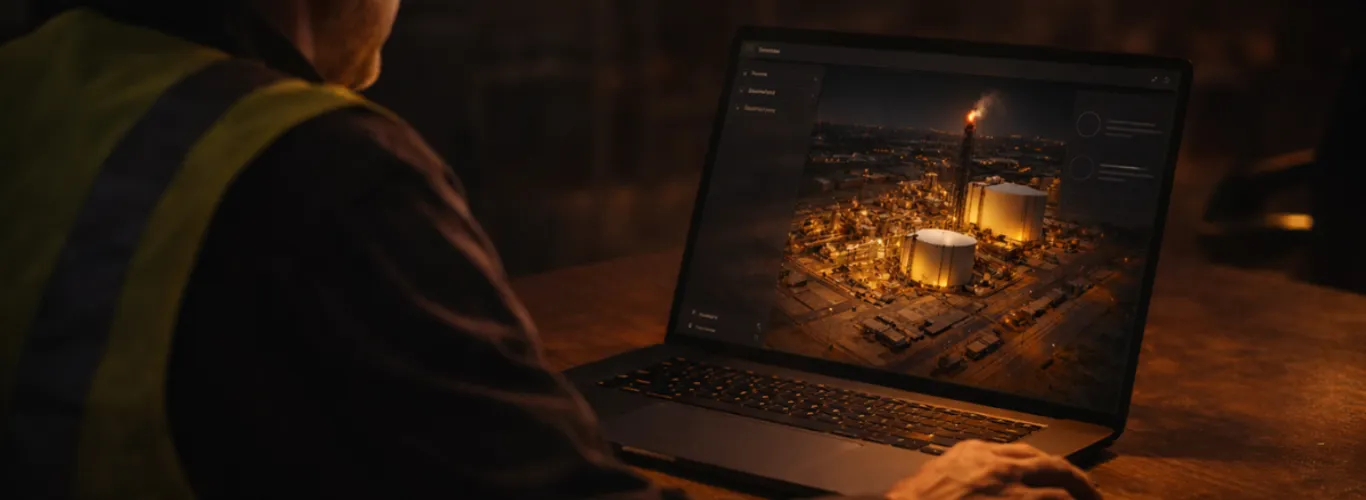
For years, PowerPoint has been the default format for tabletop exercises.
A facilitator presents a scenario through slides.
Teams discuss the response.
Notes are taken manually.
The session moves from one inject to the next.
It became standard because it works.
Slides are simple.
Easy to distribute.
Easy to update.
Easy to present in a meeting room.
For a long time, that was enough.
But emergency response training has evolved.
What Traditional Tabletop Exercises Get Right
There is a reason the format survived this long.
PowerPoint-based tabletop exercises are:
Familiar
Accessible
Low barrier to entry
Good for unguided discussions
They help align teams on procedure and encourage communication between departments.
That part still matters.
Discussions are important in emergency management.
The problem is not the existence of tabletop exercises.
The problem is the structure surrounding them.
Where Slides Begin to Break Down
PowerPoint was designed for presentations.
Not operational training.
As tabletop exercises become more complex, the limitations start to appear quickly.
Slides are static.
Incidents are not.
The facilitator controls progression manually.
Scenario changes interrupt flow.
Notes are written separately from the exercise itself.
Over time, the session becomes harder to manage.
Discussions drift.
Decisions are missed.
Reporting becomes an administrative task after the exercise ends.
Training starts to feel like work instead of preparation.
The Core Problem
Most traditional tabletop exercises separate the scenario from the system managing it.
The scenario exists on slides.
The notes exist somewhere else.
Decisions live in conversation.
Nothing is unified.
That creates friction.
What STRX Tabletop Changes
STRX Tabletop keeps the strengths of traditional tabletop exercises while removing operational weaknesses.
The discussion remains.
The facilitation remains.
The collaborative decision-making remains.
But the structure changes completely.
Instead of static slides, the scenario becomes interactive.
Instead of manual note-taking, decisions are captured automatically.
Instead of rebuilding reports afterward, the session generates structured outputs as it progresses.
The exercise becomes:
Easier to run
Easier to follow
Easier to review afterward
Without losing the collaborative nature that made tabletop exercises valuable in the first place.
Why This Matters for Emergency Response Training
Modern incident response training needs to balance realism with practicality.
Teams need exercises that are:
Fast to launch
Easy to facilitate
Structured under pressure
Repeatable across sites
PowerPoint helped standardize tabletop exercises.
But platforms like STRX Tabletop structure them.
The result is not a completely different training philosophy.
It is the same purpose, delivered through a better operational system.
The Shift Already Happening
Emergency response teams are already moving toward:
Interactive scenarios
Real-time tracking
Automatic reporting
Browser-based access
Not because discussion-based exercises disappeared.
Because the way they are run is evolving.
Final Thought
Slides helped tabletop exercises become widespread.
But widespread does not mean optimal.
The next generation of emergency response training keeps the strengths of traditional tabletop exercises while removing the friction that slows them down.
That is where structured digital tabletop platforms fit.
Try STRX Tabletop today: https://structurus.com/en/strx-tabletop
For more information, contact info@structurus.com