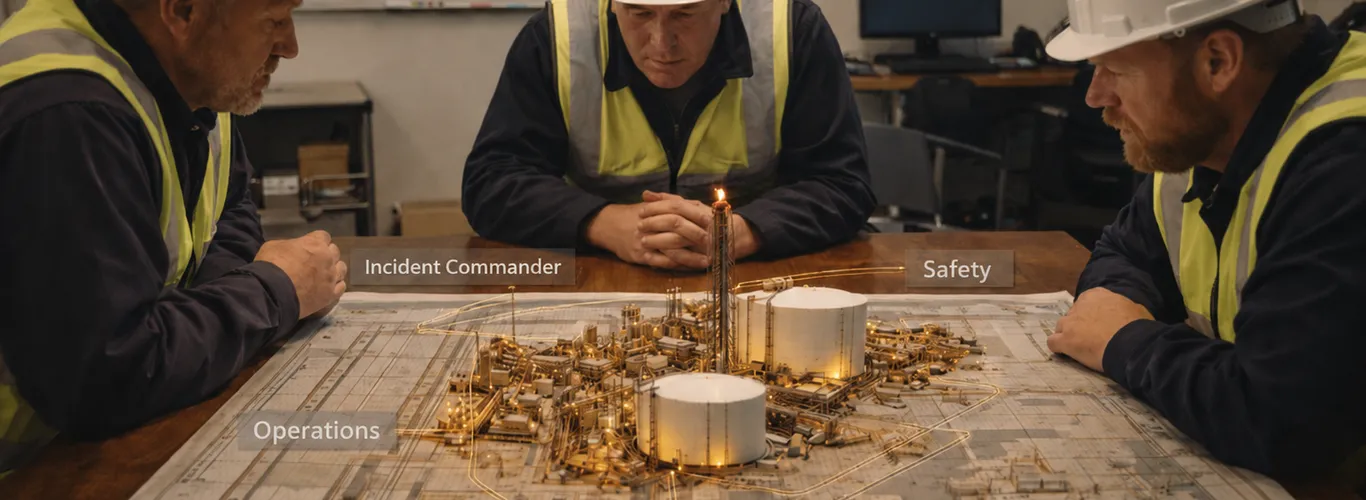
Most tabletop exercises are judged by how the session feels.
Was the discussion focused?
Did the right people attend?
Did the scenario bring value?
Was the team engaged?
Those things matter.
But they are not real outputs.
The real output is what remains after the exercise ends.
The report.
That is where many tabletop exercises fall short.
Why Reporting Matters in Emergency Response Training
Tabletop exercises are designed to test decision-making, communication, escalation, and coordination.
In incident response, those details matter.
Who made the decision?
When was it made?
What information was available at the time?
Which actions were taken?
Where did the session slow down?
Which roles were unclear?
If those details are not captured, the exercises become difficult to review.
And if it cannot be reviewed properly, it cannot be improved .
The Problem With Manual Reporting
Traditional tabletop exercises often rely on manual notes.
Someone writes down key points.
Another person remembers important decisions.
And someone else turns the session into a report afterward.
That process creates gaps.
Notes are missed.
Timelines become unclear.
Decisions are reconstructed from memory.
Important discussion points disappear.
The exercise may have been useful in the room, but the learning outcome becomes weaker once the details are lost.
For emergency response teams, that is a problem.
Training should produce clarity, not more admin.
A Better Standard for Tabletop Exercises
A strong tabletop exercise should do three things well:
It should guide the scenario.
It should capture decisions as they happen.
It should produce a report that is useful afterward.
That is the difference between a discussion and a training system.
When the report is built into the session, teams get a clearer picture of performance.
They can see what happened.
They can identify weak points.
They can adjust the next exercise with purpose.
This creates a feedback loop.
Run the exercise.
Review the output.
Improve the next session.
How STRX Tabletop Supports This
STRX Tabletop is built to make tabletop exercises more structured and easier to review.
Instead of relying on slides, scattered notes, and manual reporting, teams can run the session through a structured environment.
The scenario progresses.
Decisions are captured.
Actions are tracked.
The report is generated automatically at the end.
This does not remove the human discussion.
It improves what happens around it.
Facilitators can focus on the exercise.
Participants can focus on response.
The system handles the structure and capture.
Why This Matters for Incident Response
Incident response training is not about having a good meeting.
It is about improving readiness.
That means teams need outputs they can use.
A vague report does not help much.
A clear report shows what needs to change.
That is where tabletop exercises become more valuable.
Not because they were run once, but because each session improves the next one.
Final Thought
The session is only half of the exercise.
The report is what turns it into learning.
If these details are missing, the value drops.
If everything is captured, teams have something to build on.
That is the standard tabletop training should move toward.
Try STRX Tabletop here: https://structurus.com/en/strx-tabletop
For more information, email info@structurus.com