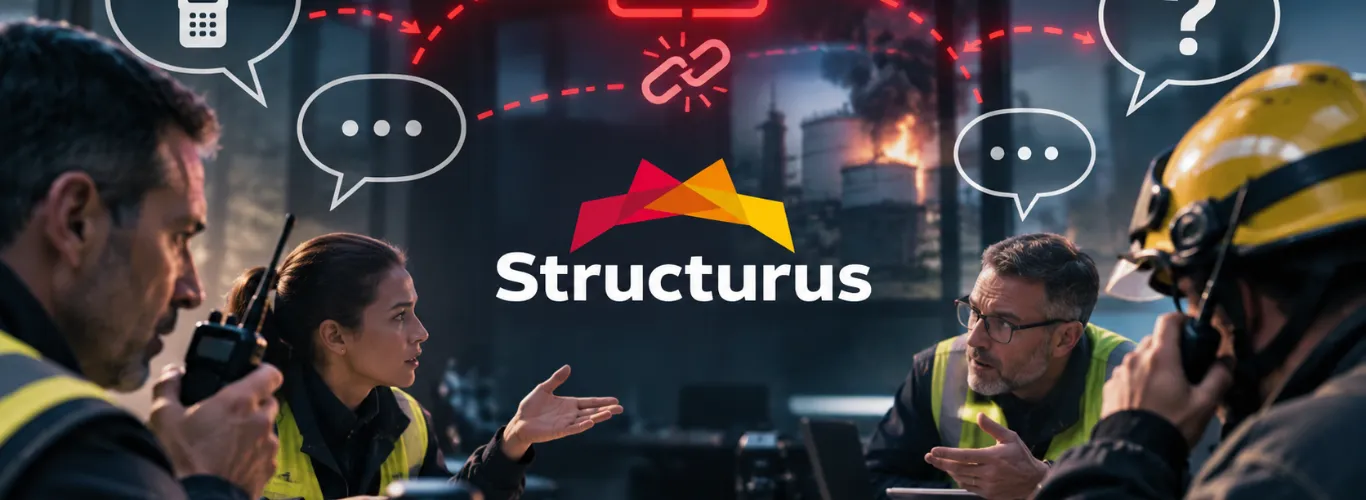
The warning was given.
The radio message was sent.
The supervisor was informed.
The instruction was passed on.
But that only proves that information left one person.
It does not prove that everybody understood the same thing.
Communication is not just transmission
Consider a simple instruction:
“Do not use the east access.”
One person might understand that the road is physically blocked.
Another might think it is being kept clear for emergency vehicles.
Someone else may believe only one entrance is affected.
The words have reached everyone.
The understanding has not.
That difference becomes important when people start making decisions based on what they believe the message meant.
Pressure makes interpretation harder
Emergency communication rarely happens in perfect conditions.
People may be dealing with multiple radio channels, phone calls, alarms, changing hazards and several teams asking for information at the same time.
Messages become shorter.
Context disappears.
Assumptions fill the gaps.
A statement that was perfectly clear to the person sending it may mean something slightly different to the person receiving it.
Multiply that across several teams and the response can begin working from different versions of the same incident.
Different teams see different parts of the problem
Firefighters may understand the immediate hazard.
Operations may understand the process equipment.
Security may know which access points are available.
Management may be coordinating external resources.
None of those perspectives is necessarily wrong.
They are incomplete.
Effective communication helps turn those separate pieces into a shared picture of what is happening.
That shared picture is what allows teams to coordinate their decisions.
Confirmation matters
One of the simplest ways to strengthen communication is to confirm important information.
Not every sentence needs repeating.
But critical information should not disappear into the system without knowing whether it has been understood.
That might mean repeating an instruction back.
Clarifying which location is being discussed.
Confirming who is responsible for the next action.
Or simply asking:
“Can you confirm you have that?”
The goal is not more radio traffic.
It is less ambiguity.
This is difficult to test on paper
A communication procedure can look completely clear when everyone is sitting calmly reading it.
The weaknesses often appear when the team has to use it while something else is happening.
A tabletop exercise can introduce information to different people at different moments.
The facilitator can then observe what happens.
Who passes it on?
Who confirms it?
Who assumes somebody else knows?
Does the information change a decision?
Do different teams end up working from different assumptions?
Those questions reveal much more than asking whether a communication plan exists.
Practise the communication, not just the response
STRX Tabletop gives teams a shared scenario where information, injects and decisions develop throughout the exercise.
That creates an opportunity to test the communication surrounding the response rather than simply discussing what should happen.
Because during a real emergency, the question is rarely just:
Was the message sent?
The more important question is:
Did everyone who needed it understand what it meant?
Try STRX Tabletop (Web Edition) today:
https://structurus.com/en/strx-tabletop
For more information, email info@structurus.com.