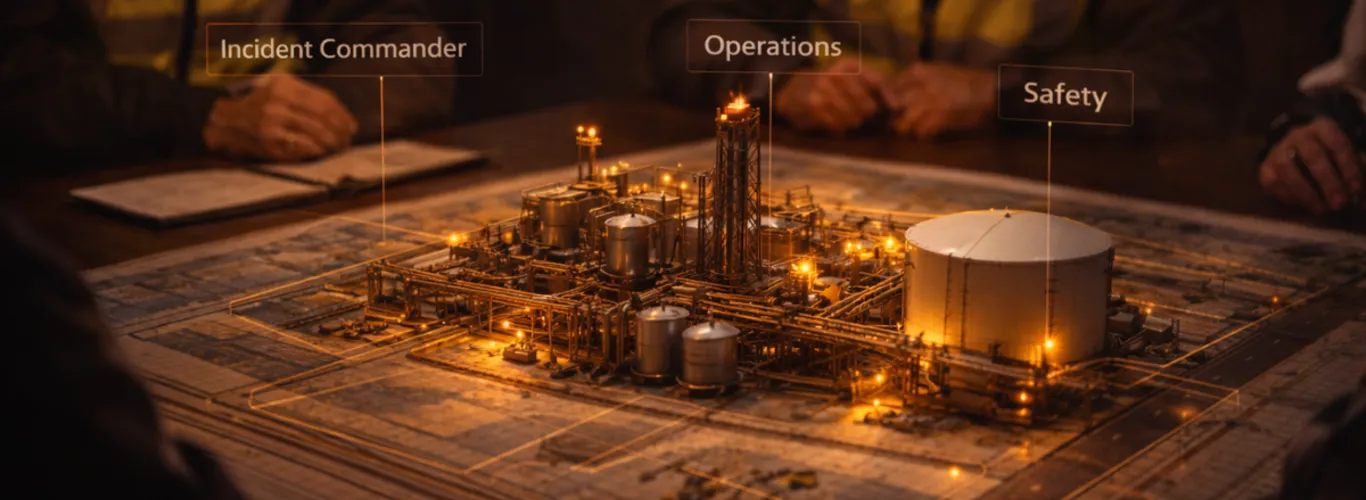
Tabletop exercises are one of the most common ways to prepare teams for emergency response.
They bring people together.
They test procedures.
They create discussions around possible incidents.
That part still matters.
But many tabletop exercises have the same weakness.
The session happens, people talk through the scenario, and then the real work begins afterward.
Someone has to collect the notes.
Rebuild the timeline.
Remember who said what.
Turn the discussion into a report.
That is where value gets lost.
The Problem with Traditional Tabletop Outputs
Most tabletop exercises rely on manual capture.
Facilitators take notes.
Participants discuss decisions.
Actions are mentioned verbally.
The report is written later.
This creates a gap between what happened in the room and what is recorded afterward.
Important decisions can be missed.
Timelines become unclear.
Weak points are harder to identify.
The exercise may feel productive, but the output is often incomplete.
For emergency response teams, that matters.
Training should not just create discussion.
It should create usable insight.
What a Good Exercise Should Produce
A strong tabletop exercise should leave teams with clear answers.
What happened?
Who responded?
What decisions were made?
Where did confusion appear?
What needs to improve?
That information is what turns a session into a feedback loop.
Without it, teams may repeat the same issues in the next exercise.
How STRX Tabletop Changes the Process
STRX Tabletop is designed to make the exercise more structured from the start.
Instead of relying only on slides, notes, and memory, the platform guides the session through a clearer workflow.
Teams can run the scenario, move through phases, capture decisions, and generate a report at the end.
The benefit is simple:
Less reconstruction.
Less admin.
More clarity.
The session becomes easier to review because the important details are captured as the exercise unfolds.
Why This Matters for Emergency Training
Emergency response training needs structure.
Not because teams lack knowledge.
Because incidents move quickly.
Decisions happen under pressure.
Roles need to stay clear.
Actions need to be tracked.
A tabletop exercise should reflect that.
When the session is structured and the report is generated automatically, teams can spend less time rebuilding what happened and more time improving what matters.
Final Thought
More slides will not fix tabletop training.
Better outputs will.
The value of an exercise is not only in the discussion.
It is in what teams can learn from afterward.
That is where structured tabletop software changes the standard.