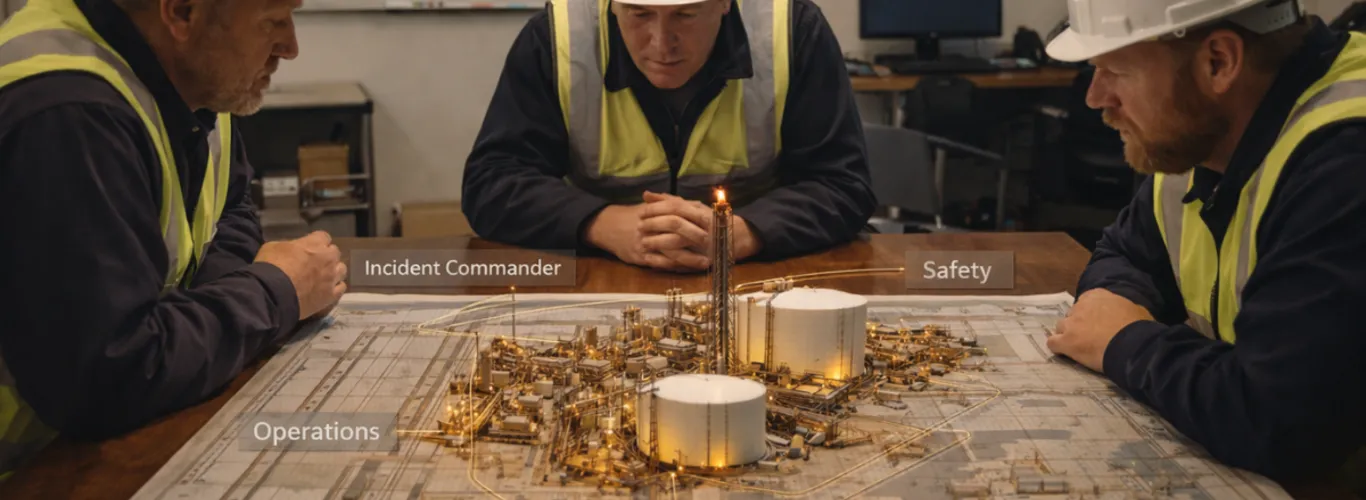
Scenario: fire inside a facility.
Within minutes:
Incident identified.
Response initiated.
Roles activated.
Decisions made and logged.
No confusion.
No chaos.
Everything structured.
Everything captured.
That’s the standard.
But most exercises don’t look like this.
What Usually Happens
The session starts well.
The scenario is introduced.
People engage.
Discussion begins.
Then it spreads.
Conversations branch out.
Decisions are spoken but not recorded.
Timelines become unclear.
Roles start to overlap.
By the end, there’s activity.
But very little clarity.
Why the Gap Exists
It’s not a people problem.
It’s a structure problem.
Most exercises rely on discussion.
They don’t enforce progression.
There’s no system ensuring:
When decisions should happen
Who owns them
How they are captured
Without that, the session becomes loose.
And once it becomes loose, it loses value.
What a Structured Exercise Changes
A well-run exercise doesn’t rely on memory.
It runs through defined phases.
Each phase introduces pressure.
Each moment requires a decision.
Each decision is recorded.
The scenario moves forward with intent.
Not everything is discussed.
Only what matters.
This is what creates:
Clear timelines
Clear ownership
Clear outcomes
There’s nothing to reconstruct afterward.
Why This Matters
In a real incident, there is no room for drift.
Decisions happen fast.
Coordination matters.
Timing matters.
Training should reflect that.
If exercises are unstructured, teams are not being trained under real conditions.
They’re being briefed.
From Activity to Outcome
The difference is simple.
Running an exercise is not the goal.
Running one that produces usable outcomes is.
If decisions are not captured, they are lost.
If structure is missing, clarity disappears.
A good session leaves you with something you can act on.
Where STRX Tabletop Fits
STRX Tabletop is designed around this exact structure.
It guides the session through:
Defined scenario phases
Clear decision points
Real-time tracking
Automatic reporting
The exercise doesn’t drift.
It moves.
And at the end, everything is already captured.
No guesswork.
No reconstruction.
Final Thought
A well-run exercise is not about how much was said.
It’s about what was decided, what was done, and what can be improved.
If it’s not structured, it’s not measurable.
If it’s not measurable, it doesn’t improve anything.
That’s the difference.
Try STRX Tabletop right now to see how a well structured and efficient tabletop exercise can be run
https://structurus.com/en/strx-tabletop