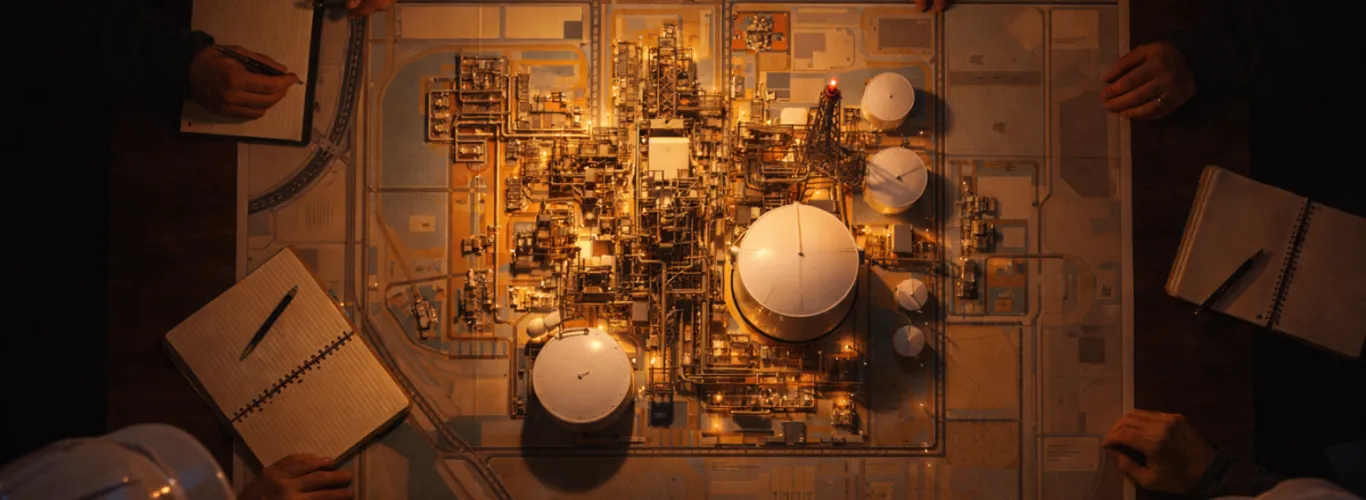
Most emergency response plans look good on paper.
They are reviewed.
Approved.
Distributed.
Roles are assigned.
Procedures are documented.
Escalation paths are defined.
Everything appears ready.
Then the exercise begins.
And something interesting happens.
People start asking questions.
Who is responsible for this decision?
What happens if the situation escalates?
Has anyone informed the external responders?
What if the primary access route is unavailable?
The plan exists.
But the team is now interacting with it in real time.
This is where the difference between a documented plan and an operational plan becomes visible.
Plans Are Static. Incidents Are Not.
A written plan is designed to provide structure.
An incident introduces uncertainty.
Information arrives gradually.
Conditions change.
New decisions become necessary.
The challenge is not whether a procedure exists.
The challenge is whether people can apply it under evolving conditions.
That is why emergency response training matters.
Not because teams need to read the plan again.
Because they need to use it.
The Gap Between Planning and Performance
Many organisations assume that because a plan exists, readiness exists.
The reality is more complicated.
A plan can be technically correct while still being difficult to execute.
Communication may break down.
Responsibilities may overlap.
Critical decisions may be delayed.
These issues are rarely visible during document reviews.
They become visible during exercises.
The exercise reveals what the document cannot.
Why Tabletop Exercises Matter
A tabletop exercise places people inside a decision-making environment.
The team must:
Interpret information.
Coordinate actions.
Manage escalation.
Prioritise resources.
Communicate effectively.
This transforms the plan from a document into an operational process.
Weak points become visible.
Assumptions get challenged.
Improvements become obvious.
That is where the value comes from.
The Problem With Traditional Tabletop Exercises
Traditional tabletop exercises often rely on:
PowerPoint slides.
Facilitator notes.
Verbal discussions.
Manual reporting.
These methods work.
But they also create friction.
Discussions drift.
Decisions get lost.
Reporting becomes a separate task after the exercise ends.
The exercise generates lessons, but those lessons are often difficult to capture consistently.
A More Structured Approach
Modern tabletop platforms are designed to keep exercises focused.
Instead of relying on slides, the scenario guides the discussion.
Decisions are captured as they happen.
Progression remains structured.
Reporting becomes automatic.
The exercise stays aligned with its purpose:
Testing how people use the plan.
Not simply reviewing the plan.
The Real Goal
The objective is not to prove that the emergency plan exists.
The objective is to discover how well it performs.
Because when an incident happens, nobody responds with a document.
They respond with decisions.
And the quality of those decisions determines the outcome.
Final Thought
You can tell a lot about an emergency plan by watching people use it.
Not by reading it.
Not by reviewing it.
Experiencing it.
That is why structured tabletop exercises remain one of the most valuable tools available for improving operational readiness.