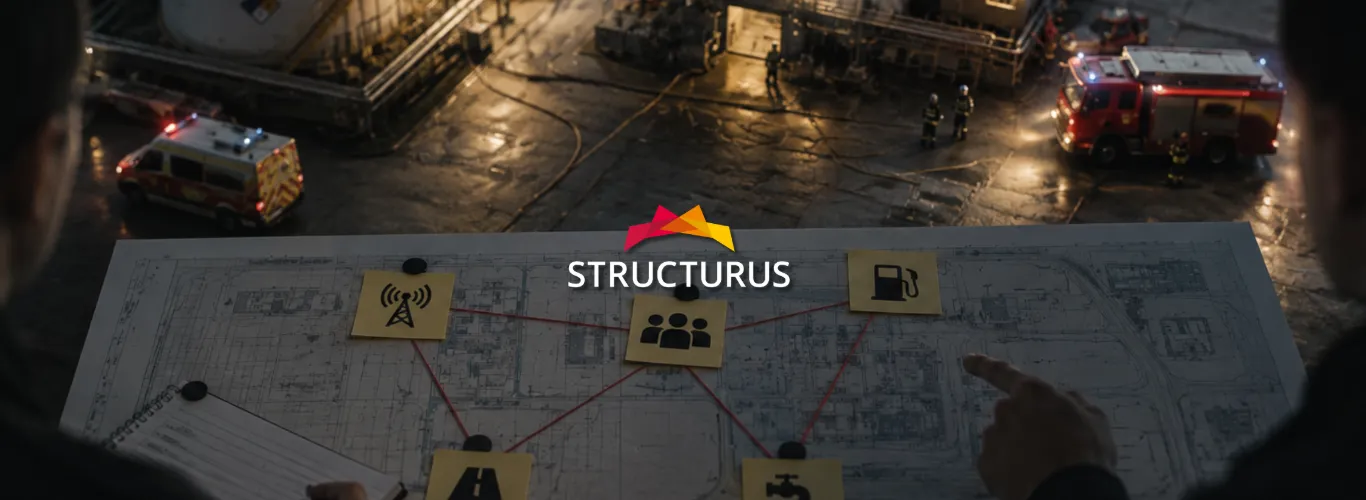
The incident is only the starting point
A fire may begin the exercise, but useful questions often come afterwards.
What happens if a gate is blocked?
What happens if the control room becomes overloaded?
What happens if a response vehicle is unavailable?
What happens if an external agency is delayed?
These complications test how resilient the response really is.
Plans often assume ideal conditions
Written procedures naturally describe how the response should work.
Real incidents rarely stay that clean.
Resources can be unavailable. Information can be delayed. Responsibilities can overlap.
A strong tabletop exercise introduces enough friction to find out whether the plan still works.
Dependencies make better injects
Injects can be used to deliberately test weak points.
A communications failure tests alternatives.
A delayed resource tests priorities.
A blocked route tests site knowledge.
Reduced staffing tests whether responsibilities are understood.
The objective is not to make the exercise chaotic. It is to reveal where the response relies too heavily on one assumption.
Test what the response relies on.
STRX Tabletop allows facilitators to introduce injects, track decisions and develop the scenario through structured phases.
That makes it possible to test both the incident and the systems supporting the response.
A good exercise should not simply ask:
Can we handle this emergency?
It should also ask:
What do we depending on to make that possible?
Try STRX Tabletop (Web Edition) today for free and test your dependencies:
https://structurus.com/en/strx-tabletop
For more information, email info@structurus.com.