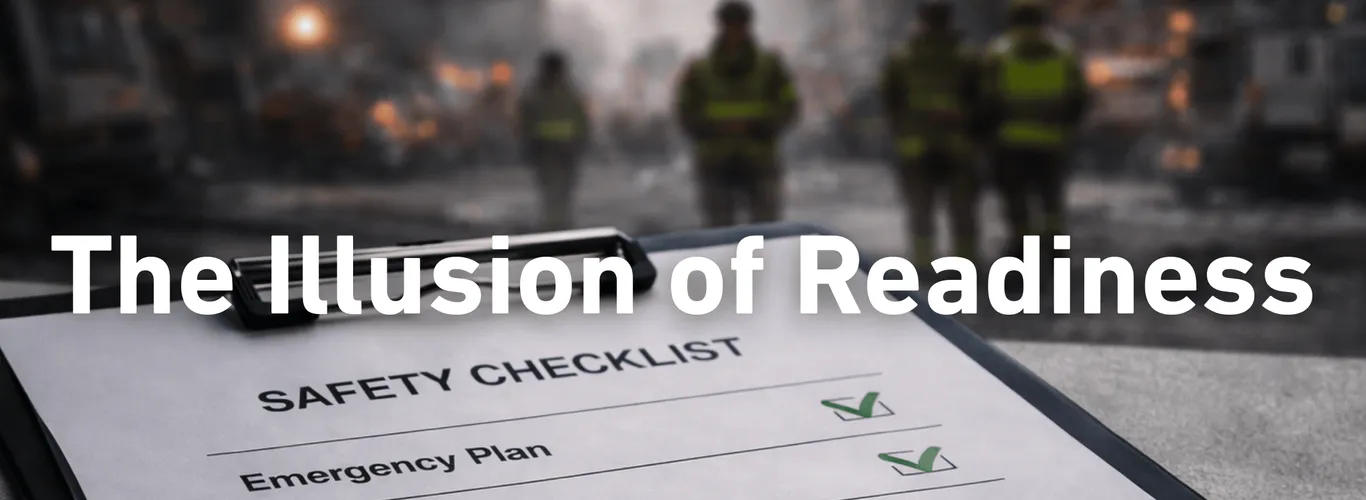
Most organisations believe they are ready.
They have emergency response plans.
They run drills.
They train their teams.
They pass audits.
They meet compliance requirements.
On the surface, everything looks solid.
And yet, when real incidents occur, the same patterns repeat: hesitation, miscommunication, delayed decisions, and unexpected escalation. Not because people don’t care — but because readiness was assumed, not proven.
This is the illusion of readiness.
Why Readiness Is So Easy to Overestimate
Readiness feels reassuring.
It’s reinforced by documents, procedures, certifications, and completed training sessions. These are visible, measurable, and reportable.
But emergencies don’t measure preparedness in documents.
They expose it in behaviour.
Under pressure, people don’t operate at the level of their plans. They operate at the level of their experience.
That gap — between what is written and what is practised — is where the illusion forms.
Plans Create Confidence. Pressure Tests It.
Emergency response plans are written in controlled conditions.
They assume clear communication, available resources, stable access routes, and orderly decision-making.
Real incidents don’t.
Noise rises.
Visibility drops.
Information is incomplete.
Multiple problems emerge at once.
Time compresses.
In those moments, teams are forced to adapt. And adaptation only works if it has been practised.
Without that practice, the plan doesn’t fail outright — it quietly stops guiding behaviour.
Training Can Reinforce the Illusion
Traditional training often strengthens confidence without testing capability.
Scripted drills.
Predictable scenarios.
Known outcomes.
Minimal consequence for mistakes.
Teams perform well because the environment is controlled.
Leadership walks away reassured.
But nothing has been stressed.
Nothing has been challenged.
Nothing has been revealed.
The illusion remains intact.
What Real Readiness Actually Looks Like
Real readiness is uncomfortable.
It comes from:
Seeing where coordination breaks
Experiencing how fast conditions change
Feeling the cost of hesitation
Practising decisions when information is incomplete
Repeating scenarios until instinct replaces deliberation
It doesn’t come from one successful exercise.
It comes from consistent exposure to realistic conditions.
This is where many organisations struggle — not because they don’t want realism, but because realism is hard to deliver frequently without disruption.
How STRX Breaks the Illusion
STRX exists to replace assumption with evidence.
Instead of reviewing plans, teams operate inside them.
Instead of predictable drills, conditions change dynamically.
Instead of generic scenarios, training reflects real sites and real constraints.
Instead of isolated exercises, multiple teams train together in the same environment.
The result is clarity.
Teams see what works.
They see what doesn’t.
Leadership gains visibility into actual readiness — not perceived readiness.
And most importantly, gaps are exposed early, safely, and repeatedly — before reality does it for them.
Preparedness Isn’t a Feeling
Preparedness is demonstrated under pressure.
The organisations that perform best in real incidents are not the ones that feel the most confident — they are the ones that have already experienced uncertainty, complexity, and escalation in training.
They’ve already broken the illusion.