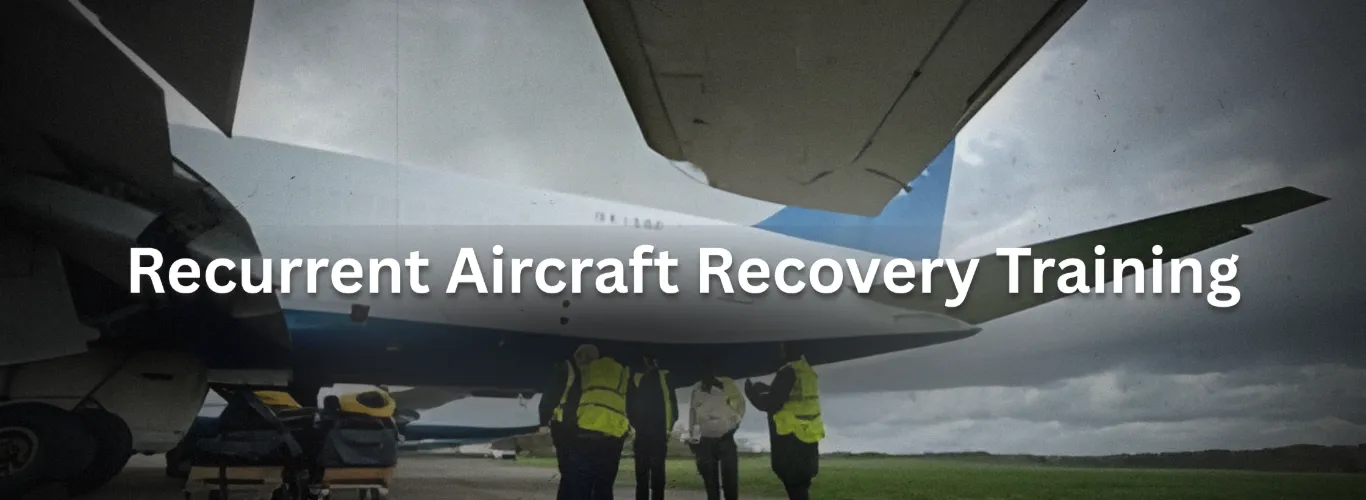
Aircraft recovery is one of the most unforgiving operations an airport will ever carry out.
It is performed rarely.
It is executed under pressure.
And when it goes wrong, the consequences extend far beyond the aircraft itself.
That combination alone makes recurrent training essential — not optional.
A High-Risk Task You Rarely Get to Practice
Aircraft recovery sits in a dangerous category: high consequence, low frequency.
Most recovery teams may go years without performing a live recovery. During that time:
Personnel change
Equipment is upgraded
Aircraft types evolve
Procedures are revised
Muscle memory fades
Yet when a recovery is required, the expectation is immediate competence.
Initial training establishes qualifications.
Recurrent training preserves capability.
Without it, teams are expected to perform complex, safety-critical tasks from memory under stress — often with unfamiliar variables introduced by damage, terrain, or time pressure.
Why Skill Fade Is a Real Risk
Aircraft recovery is not intuitive work.
It involves:
Precise load calculations
Coordinated multi-team movement
Correct sequencing of actions
Safe use of specialized lifting and recovery equipment
Continuous risk assessment during execution
These are perishable skills.
Without regular reinforcement, even experienced personnel can hesitate, misjudge sequencing, or default to outdated practices — increasing the risk of secondary damage or injury.
Recurrent training exists to prevent exactly that.
Regulatory Expectations Support Recurrent Training
While no single regulation mandates a fixed renewal interval, international guidance consistently reinforces the need for recurrent competence.
ICAO Annex 14, Volume I places responsibility on aerodrome operators to ensure emergency and recovery personnel are trained and competent at all times.
ICAO Doc 9774 (Manual on Aircraft Recovery) explicitly identifies recovery as a high-risk, low-frequency activity and states that initial training alone is insufficient.
ICAO Doc 9137, Part 7 recognises that emergency and recovery tasks are rarely performed operationally and therefore require regular exercises and reassessment.
EASA ADR.OPS.B.005 and ADR.OR.D.017 require personnel involved in safety-critical aerodrome functions to be trained, competent, and kept current.
Safety Management System (SMS) principles require organizations to actively manage skill degradation and competence risk.
Taken together, the direction is clear: competence must be maintained, not assumed.
The Operational Cost of Getting It Wrong
An improperly executed recovery can:
Cause additional structural damage to the aircraft
Damage runway or taxiway surfaces
Extend airport closures
Increase safety risk to personnel
Trigger regulatory scrutiny and investigation
In many cases, the secondary consequences outweigh the original incident.
Recurrent training reduces that risk by ensuring teams are not learning during a live event.
The Industry Is Not Standing Still
Recurrent training is becoming more important, not less.
The industry continues to evolve:
New aircraft designs and landing gear configurations
Updated OEM recovery procedures
New generations of recovery equipment and lifting systems
Lessons learned from real recovery events worldwide
Training conducted once, years ago, cannot account for those changes.
Recurrent Training Is About Readiness, Not Compliance
The purpose of recurrent aircraft recovery training is not to satisfy a checklist.
It is to ensure that when recovery is required:
Teams act decisively
Procedures are executed correctly
Risks are controlled
Secondary damage is avoided
Aircraft recovery is not the moment to “refresh” knowledge.
It is the moment that reveals whether knowledge was maintained.
Conclusion
Aircraft recovery will always be rare.
That is exactly why recurrent training matters.
When an operation is performed infrequently but carries high risk, readiness cannot be theoretical. It must be practiced, reinforced, and kept current.
Recurrent aircraft recovery training is not an added layer of safety.
It is the layer that prevents a bad day from becoming worse.